
There’s a particular kind of sentence a student with dyslexia writes when they’re being careful. It’s short. It uses small, safe words. It says much less than the student knows, because every longer word they reached for was a word they weren’t sure how to spell — so they didn’t reach.
That’s the part of dyslexia that rarely makes it into the definition. Most people picture reading. But for a huge number of students the harder daily problem is the reverse: getting what’s in their head onto the page, when spelling turns every sentence into a series of small interruptions.
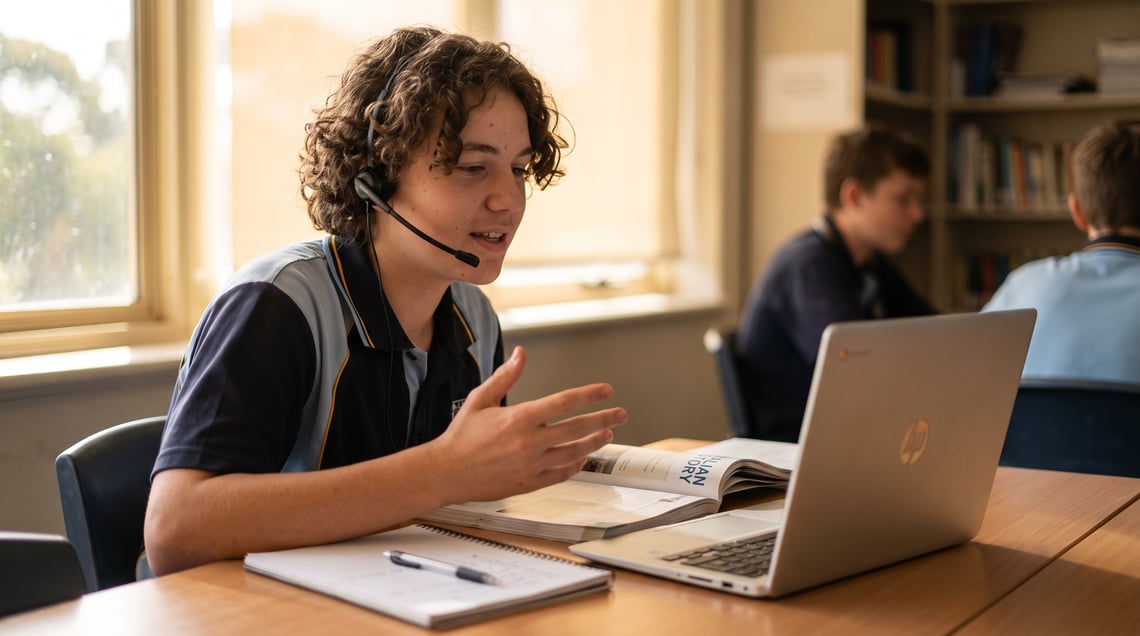
Dictation changes that equation. Not by fixing spelling — it doesn’t — but by taking spelling out of the way of composition, so the student can write at the level they actually think.
Dyslexia and the spelling tax
Dyslexia is a difference in how the brain processes the sounds and structure of language. Reading is where it’s usually identified, but the same underlying difficulty with mapping sounds to letters makes spelling effortful and often unreliable — frequently for life, even in adults who have long since learned to read well. In Australia, dyslexia is estimated to affect around one in ten people, and language-based learning differences as a group affect an estimated 15 to 20% of the population, according to the International Dyslexia Association.
Here’s why that matters for writing specifically. Composing a sentence already asks a lot at once: holding the idea, choosing the words, ordering them, keeping grammar and punctuation in view. A fluent speller does the spelling part automatically, so none of that budget is spent on it. A student with dyslexia pays a tax on every uncertain word — stop, sound it out, second-guess it, maybe swap it for an easier word, then try to remember where the sentence was going. Do that six times in a paragraph and the paragraph is exhausting, slow, and shorter than the student’s actual thinking.
This is the gap teachers see: a student who talks about a book with real insight and then hands in writing that looks like it came from someone with far less to say. The writing isn’t measuring their understanding. It’s measuring their spelling.
What changes when a student can dictate
They compose in full sentences again. Speaking, the student never has to stop at a hard word — they just say it. The thought comes out whole, in the vocabulary they’d actually use out loud, instead of the reduced vocabulary of words they can spell under pressure.
The writing starts to match the talking. Parents and teachers often describe the same surprise as with other writing difficulties: the first dictated piece reads like the student sounds in conversation. Nothing about their ability changed. The channel stopped throttling it.
Effort moves to where it belongs. Freed from spelling, the student can spend their attention on the argument, the structure, the choice of a better word — the parts of writing that are actually worth their effort, and that spelling was crowding out.
What the research says — and the catch that matters most
Studies of speech-to-text with dyslexic students are consistent on the upside: given dictation, students can produce longer and more accurate texts than they manage by hand or keyboard, because the spelling barrier is removed at the point of composing. A 2026 study in Dyslexia looking closely at the writing process found students could get more of their thinking down when they weren’t fighting transcription.
The catch is important, and this article would be dishonest without it. Speech-to-text does not teach a student to read or spell. It’s an access tool, not a literacy intervention — it should sit alongside proper structured literacy teaching, not replace it. And it brings a new task of its own: the errors it produces are different from spelling errors. Where a dyslexic student’s own draft might contain a misspelling, a dictated draft contains the wrong word spelled perfectly — “their” for “there,” a misheard name, a homophone that a spellchecker sails straight past. Those are harder to catch, precisely because they look correct. Students need to be taught to proofread dictated work specifically, ideally by reading it back or having it read aloud.
That’s not a reason to avoid dictation. It’s the difference between a student who uses it well and one who trusts it too much.
Making it work in practice
Separate composing from correcting. The power of dictation is that the student can get the whole idea out without stopping. Encourage exactly that — dictate the draft freely, fix it afterwards. Trying to perfect each sentence while speaking throws away the main benefit.
Teach the proofreading, not just the speaking. Dictating well is a skill — full sentences, punctuation commands, a beat between thoughts. Our guide to spoken punctuation is a good place to start. But for dyslexia especially, build in the review step: read it back, or listen to it read aloud, to catch the correct-looking wrong words.
Get the microphone right. Recognition accuracy depends on clean audio. A laptop’s built-in mic in a noisy classroom is not clean audio, and misrecognitions add to the proofreading load. A decent headset is the cheapest accuracy improvement available.
Frame it as an accommodation, not a shortcut. Glasses aren’t cheating at reading, and dictation isn’t cheating at writing. Students take their cue from the adults around them; name it plainly as how this student writes, and it’s far more likely to stick.
Dyslexia and students with dysgraphia often overlap, and the practical setup is much the same — the difference is mainly where the bottleneck sits: spelling and decoding for dyslexia, the physical act of writing for dysgraphia. Many students have a bit of both.
Where Speech Recognition Cloud comes in
Speech Recognition Cloud was built by Russell Bewsell, who has spent 28 years working with Australian schools, students and people across a wide range of disabilities and support needs — backed by Voice Recognition Australia and 25-plus years of speech recognition expertise.
It’s designed to be put to work with as little setup as possible: no voice-profile training to sit through, no calibration. You place the cursor where you want text, press a hotkey, speak naturally, and the punctuated sentence appears — in Word, in Google Docs, in an online assignment form, anywhere on Windows. It’s the same speech to text for students and academics range used in schools around the country, with dedicated pages on speech to text for students and speech to text in the classroom for specific settings.
The honest way to judge whether it helps a particular student is to try it on real work — a piece of writing they’ve been avoiding. The free edition includes 20 minutes of dictation a month, which is enough to watch a student say a paragraph they’d never have written by hand, and see the difference for yourself.
For a lot of families, that first paragraph settles a question they’ve been asking for years: the ideas were always there. The spelling was just in the way.
If a school or university is licensing for a group rather than an individual, volume licensing for schools and universities covers how that works.
Related reading
- Speech recognition for students with dysgraphia
- Dictation for students and education
- Accessibility and RSI
- Dictation for teachers and educators
Sources